I. Historical Context
The theoretical foundations and early programs (1950s Onwards)
The Turing Test
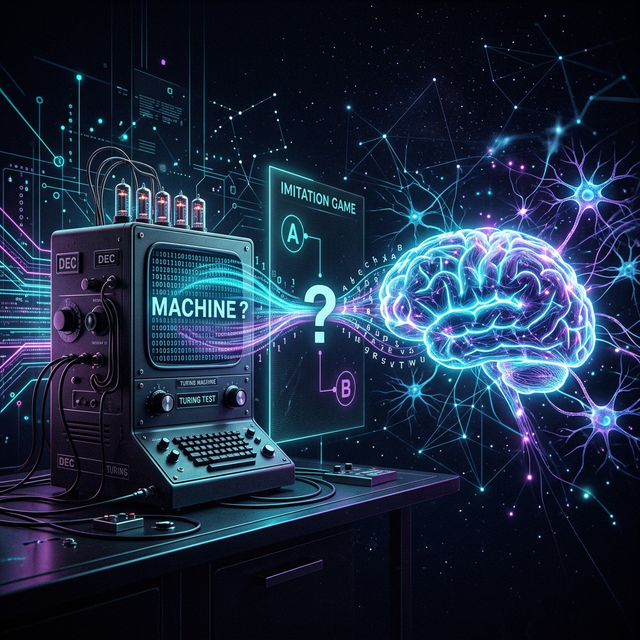
Key Figure: Alan Turing
Alan Turing publishes "Computing Machinery and Intelligence," introducing a theoretical measure for machine intelligence that would become famous as the Turing Test, asking the fundamental question: "Can machines think?"
Original Publication (Mind)The Birth of "AI"
Key Figures: John McCarthy, Marvin Minsky, Nathaniel Rochester, Claude Shannon
The Dartmouth Summer Research Project on Artificial Intelligence is organized. The term "Artificial Intelligence" is officially coined here, marking the formal academic birth of the field as an independent discipline.
Original Dartmouth ProposalThe Perceptron
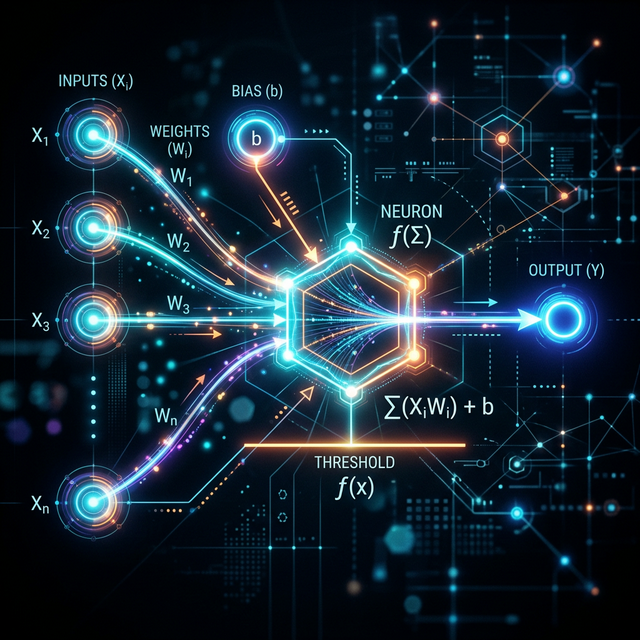
Key Figure: Frank Rosenblatt
Frank Rosenblatt invents the Perceptron, an early artificial neural network, at the Cornell Aeronautical Laboratory. This hardware implementation laid the crucial groundwork for modern computational machine learning architectures.
Psychological Review ArchiveELIZA Simulates Conversation

Key Figure: Joseph Weizenbaum
Joseph Weizenbaum at MIT creates ELIZA, an early natural language processing computer program designed to simulate a Rogerian psychotherapist, demonstrating shocking early success in human-computer interaction.
CACM Official PublicationCritique of Neural Networks

Key Figures: Marvin Minsky, Seymour Papert
Minsky and Papert publish the book Perceptrons, mathematically proving limitations of early, single-layer neural networks (specifically concerning the XOR problem). This profound critique caused funding bodies to shift money away from connectionist research for a decade.
MIT Press PublicationII. The AI Winters
Cyclical periods of collapsed funding, waning academic interest, and shattered public enthusiasm, triggered by unfulfilled hype.
The First AI Winter

Causes: Researchers realized toy problems
didn't
scale. The UK's Lighthill Report (1973) criticized the field's lack of progress. In the
US,
DARPA drastically cut grants for undirected theoretical AI research, especially in
machine
translation.
Impacts: Academic funding collapsed entirely. It
became
extraordinarily difficult to secure a research grant if a proposal explicitly referenced
"Artificial Intelligence."
The Expert Systems Boom
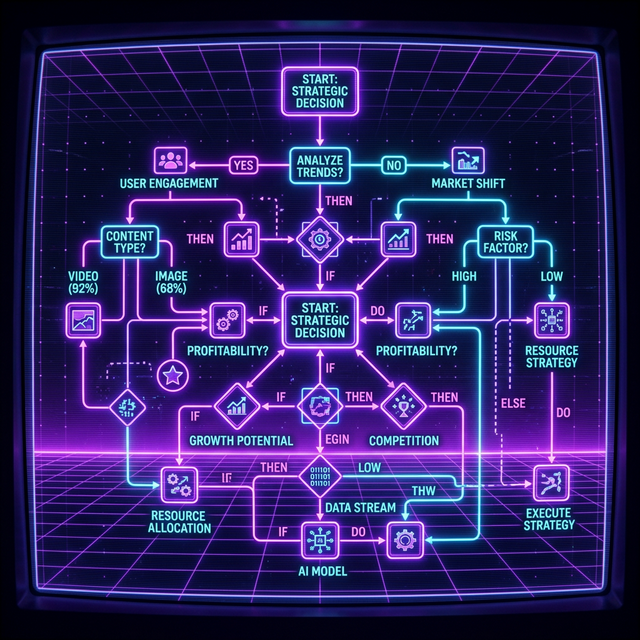
A temporary "thaw" in the AI winter. Millions were invested globally into Expert Systems—highly specialized logic programs designed to mimic the decision-making ability of human experts, such as XCON used by Digital Equipment Corporation. This led to a brief, massive surge in corporate AI adoption before their inherent brittleness caused the subsequent crash.
Our World in Data: AI HistoryThe Second AI Winter

Causes: The sudden commercial collapse of
highly
specialized "Expert Systems" (corporate logic programs mimicking experts, like XCON).
These
tools proved incredibly brittle and expensive to maintain. Concurrently, specialized
computing hardware crashed because desktop PCs (IBM/Apple) became cheaper and vastly
more
powerful.
Impacts: Hundreds of AI-focused startups went
bankrupt. AI
became an actively avoided buzzword in corporate tech, forcing research underground or
forcing rebranding into fields like "Informatics" or "Machine Learning."
III. Deep Learning & The Modern Era
The current booming renaissance propelled by massive datasets (Big Data), highly scalable Cloud Computing infrastructure, and deep algorithmic breakthroughs.
IBM Deep Blue Defeats Kasparov

Key Players: IBM, Garry Kasparov
IBM's Deep Blue supercomputer officially defeats reigning world chess champion Garry Kasparov. It becomes the first computer system to defeat a reigning world champion in a match under standard chess tournament time controls, marking a massive milestone for symbolic, brute-force search AI.
Computer.org: Evolution of AIHardware Acceleration & CUDA
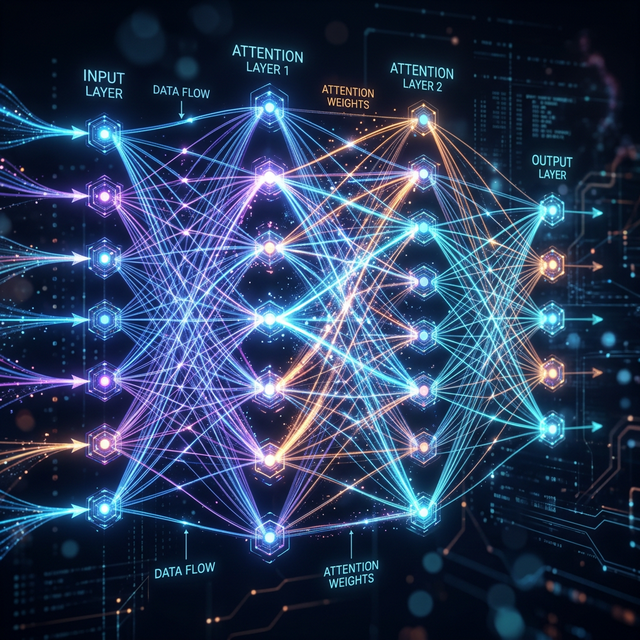
Key Players: Nvidia
Nvidia releases the Compute Unified Device Architecture (CUDA), allowing software developers to utilize Graphics Processing Units (GPUs) for general purpose processing. Researchers soon realize that GPUs—originally designed for rendering video game graphics—are exceptionally good at the parallel matrix multiplications required to train neural networks.
YouTube: History of AIIBM Watson Wins Jeopardy!

Key Players: IBM
IBM Watson competes on the quiz show Jeopardy! against former winners Brad Rutter and Ken Jennings and wins the first place prize. Watson proves that artificial intelligence can ingest massive amounts of unstructured natural language text and answer complex trivia questions in real-time.
Computer.org: Evolution of AIThe Deep Learning Breakthrough
Key Figures: Alex Krizhevsky, Ilya Sutskever, Geoffrey Hinton
Researchers win the ImageNet computer vision competition by a massive margin using a Convolutional Neural Network (CNN) called AlexNet. Crucially, they utilized parallel processing GPUs to train their model, triggering the modern deep learning revolution.
NeurIPS Abstract (AlexNet)Generative AI is Born

Key Figure: Ian Goodfellow
Ian Goodfellow introduces Generative Adversarial Networks (GANs), a groundbreaking class of machine learning frameworks that pit neural networks against each other, enabling AI to generate highly realistic, novel synthetic images and complex data forms.
ArXiv Pre-print (GANs)AlphaGo Defeats Master
Key Players: DeepMind, Demis Hassabis
DeepMind (acquired by Google and led by Demis Hassabis) creates AlphaGo. Using deep reinforcement learning, the system successfully defeats 18-time world champion Lee Sedol in Go, a highly complex board game previously thought decades out of reach for machines.
Nature Journal (AlphaGo)The Transformer Architecture
Key Players: Google Brain
Google researchers publish the seminal paper "Attention Is All You Need," introducing the Transformer model. This architecture fundamentally changes NLP by allowing efficient parallel processing of contextual data, serving as the hidden core architecture for all modern Large Language Models (LLMs).
ArXiv Pre-print (Transformers)The Cloud Catalyst

The Enablers: AWS, Google Cloud, Microsoft Azure
Tech giants made it possible to rapidly scale computing power. Instead of organizations having to build rigid on-premise supercomputers, they could train massive deep learning algorithms using these vastly scalable, on-demand cloud clusters equipped with thousands of specialized GPUs, democratizing AI research capability.
Documentary: History of AIGPT-3 Shows "Few-Shot" Power

Key Player: OpenAI
OpenAI releases GPT-3, an enormous LLM featuring 175 billion parameters. It demonstrates remarkable "few-shot learning" capabilities, shockingly capable of generating highly sophisticated, coherent, human-like text across a massive variety of tasks.
ArXiv Pre-print (GPT-3)The Generative AI Boom: ChatGPT
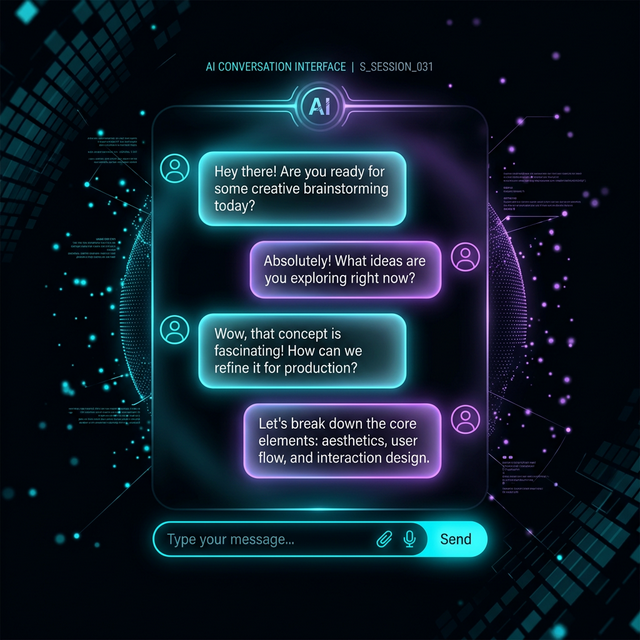
Key Player: OpenAI
OpenAI formally launches ChatGPT to the wide public. It explicitly marks the shift of AI from abstract academic tools to mainstream, ubiquitous consumer applications, rapidly becoming the fastest-growing consumer application in history and sparking a ferocious global corporate race for AI supremacy.
OpenAI Official AnnouncementReferences
Anyoha, R. (2017, August 28). The history of artificial intelligence. Science in the
News.
Harvard University.
https://sitn.hms.harvard.edu/flash/2017/history-artificial-intelligence/
ColdFusion. (2023). The history of artificial intelligence (Documentary) [Video].
YouTube.
https://www.youtube.com/watch?v=mSd9nmPM7Vg
Guzman, A. (n.d.). Evolution of AI. IEEE Computer Society.
https://www.computer.org/publications/tech-news/research/evolution-of-ai
IBM. (2021). Deep Blue. IBM History.
https://www.ibm.com/ibm/history/ibm100/us/en/icons/deepblue/
Marr, B. (2020). The 15 most important AI milestones. Forbes.
https://www.forbes.com/sites/bernardmarr/2020/12/14/the-15-most-important-ai-milestones/
Roser, M. (2022). The brief history of artificial intelligence: The world has changed fast –
what
might be next? Our World in Data.
https://ourworldindata.org/brief-history-of-ai
Turing, A. M. (1950). Computing machinery and intelligence. Mind, 59(236), 433–460.
https://doi.org/10.1093/mind/LIX.236.433